How to start?
h1 title1
Price fluctuations result from supply-demand imbalance…
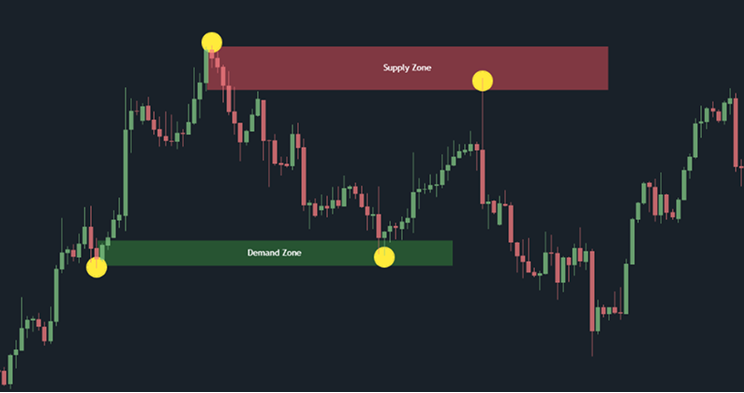
greater focus on the underlying market mechanics that drive price movement. In financial markets, price fluctuations are fundamentally the result of an imbalance between supply and demand, in the same way that product prices in the real economy are shaped by the interaction of buyers and sellers. This strategy aims to identify key price zones where supply or demand is particularly strong. These zones often serve as turning points where institutional participants enter or exit large positions, creating significant price reactions. Traders who apply this methodology typically seek to enter positions from these zones, taking advantage of the expected reversal or continuation that follows.
Price fluctuations result from supply-demand imbalance…
greater focus on the underlying market mechanics that drive price movement. In financial markets, price fluctuations are fundamentally the result of an imbalance between supply and demand, in the same way that product prices in the real economy are shaped by the interaction of buyers and sellers. This strategy aims to identify key price zones where supply or demand is particularly strong. These zones often serve as turning points where institutional participants enter or exit large positions, creating significant price reactions. Traders who apply this methodology typically seek to enter positions from these zones, taking advantage of the expected reversal or continuation that follows.
Price fluctuations result from supply-demand imbalance…
greater focus on the underlying market mechanics that drive price movement. In financial markets, price fluctuations are fundamentally the result of an imbalance between supply and demand, in the same way that product prices in the real economy are shaped by the interaction of buyers and sellers. This strategy aims to identify key price zones where supply or demand is particularly strong. These zones often serve as turning points where institutional participants enter or exit large positions, creating significant price reactions. Traders who apply this methodology typically seek to enter positions from these zones, taking advantage of the expected reversal or continuation that follows.
Price fluctuations result from supply-demand imbalance…
greater focus on the underlying market mechanics that drive price movement. In financial markets, price fluctuations are fundamentally the result of an imbalance between supply and demand, in the same way that product prices in the real economy are shaped by the interaction of buyers and sellers. This strategy aims to identify key price zones where supply or demand is particularly strong. These zones often serve as turning points where institutional participants enter or exit large positions, creating significant price reactions. Traders who apply this methodology typically seek to enter positions from these zones, taking advantage of the expected reversal or continuation that follows.
h1 title2
Price fluctuations result from supply-demand imbalance…
greater focus on the underlying market mechanics that drive price movement. In financial markets, price fluctuations are fundamentally the result of an imbalance between supply and demand, in the same way that product prices in the real economy are shaped by the interaction of buyers and sellers. This strategy aims to identify key price zones where supply or demand is particularly strong. These zones often serve as turning points where institutional participants enter or exit large positions, creating significant price reactions. Traders who apply this methodology typically seek to enter positions from these zones, taking advantage of the expected reversal or continuation that follows.
Supply and Demand Zones 2
Price fluctuations result from supply-demand imbalance…
greater focus on the underlying market mechanics that drive price movement. In financial markets, price fluctuations are fundamentally the result of an imbalance between supply and demand, in the same way that product prices in the real economy are shaped by the interaction of buyers and sellers. This strategy aims to identify key price zones where supply or demand is particularly strong. These zones often serve as turning points where institutional participants enter or exit large positions, creating significant price reactions. Traders who apply this methodology typically seek to enter positions from these zones, taking advantage of the expected reversal or continuation that follows.
h1 title3
Price fluctuations result from supply-demand imbalance…
greater focus on the underlying market mechanics that drive price movement. In financial markets, price fluctuations are fundamentally the result of an imbalance between supply and demand, in the same way that product prices in the real economy are shaped by the interaction of buyers and sellers. This strategy aims to identify key price zones where supply or demand is particularly strong. These zones often serve as turning points where institutional participants enter or exit large positions, creating significant price reactions. Traders who apply this methodology typically seek to enter positions from these zones, taking advantage of the expected reversal or continuation that follows.
Supply and Demand 4
Price fluctuations result from supply-demand imbalance…
greater focus on the underlying market mechanics that drive price movement. In financial markets, price fluctuations are fundamentally the result of an imbalance between supply and demand, in the same way that product prices in the real economy are shaped by the interaction of buyers and sellers. This strategy aims to identify key price zones where supply or demand is particularly strong. These zones often serve as turning points where institutional participants enter or exit large positions, creating significant price reactions. Traders who apply this methodology typically seek to enter positions from these zones, taking advantage of the expected reversal or continuation that follows.